France-Born Stars of the 2026 World Cup: Wearing the World's Colors | PlusAkili
Sport
France-Born Stars of the 2026 World Cup: Wearing the World's Colors
Around 174 France-born players feature at the 2026 World Cup, many representing African nations like Algeria, DR Congo, Senegal and Ivory Coast over France.
One of the most remarkable storylines of the 2026 World Cup has nothing to do with a single goal or a single team. It's a number — and what that number says about football, migration, and identity in the modern game.
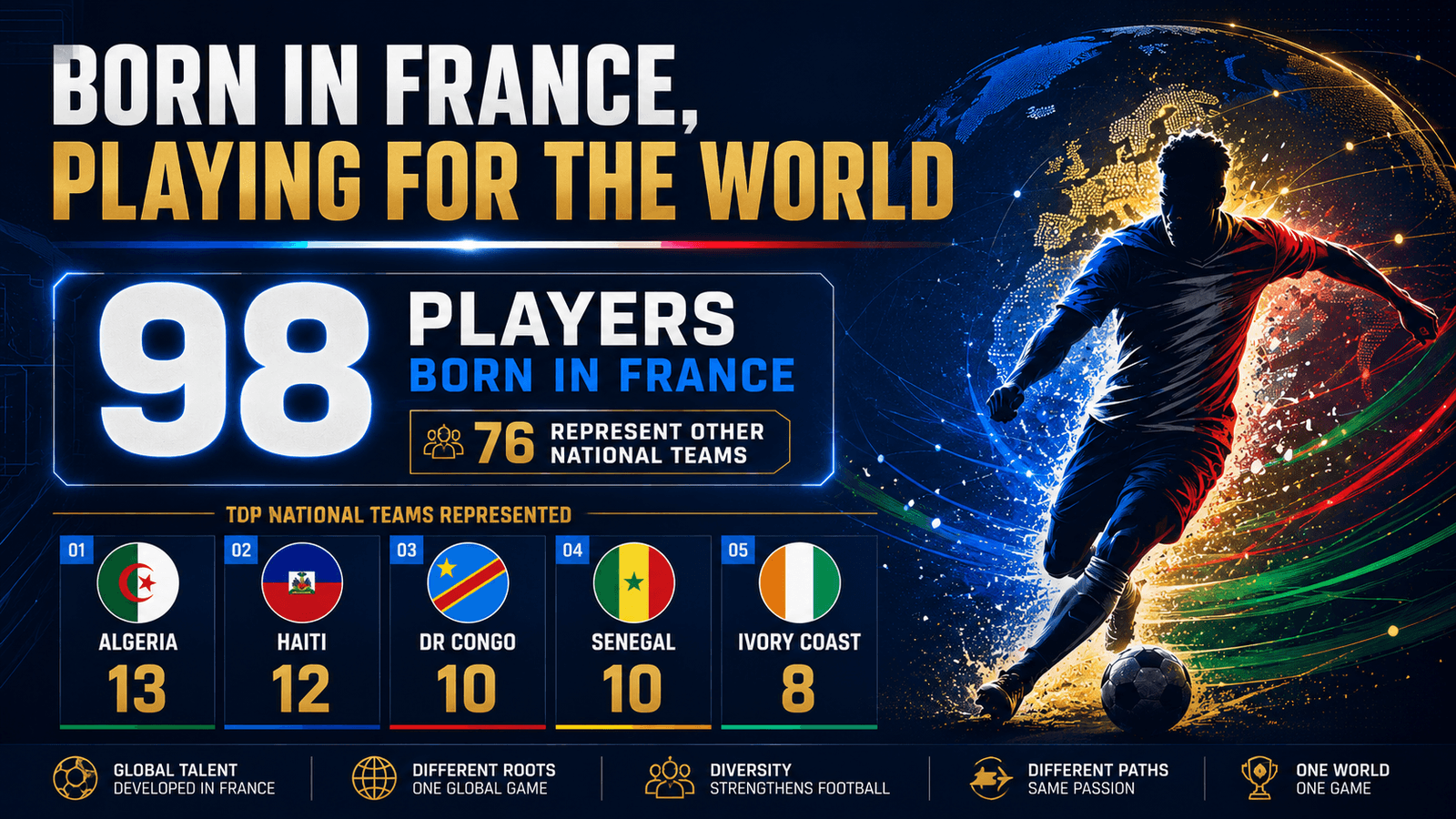
Of the 1,248 players selected across all 48 squads at this tournament, around 98 were born in France. That alone is staggering: roughly one in every twelve players at the World Cup came into the world on French soil. But here's the twist that makes the story so compelling — only about 23 of them are actually playing for France. The other 76 are representing other nations, many of them African.
France isn't just a footballing superpower in its own right. It has become the single biggest exporter of talent to rival national teams on the planet.
The Numbers by Nation
When you break down where these France-born players ended up, the African connection jumps off the page:
Algeria leads the way with 13 France-born players.
Haiti follows with 12.
DR Congo and Senegal each field around 10.
Ivory Coast rounds out the top tier with 8.
DR Congo's run to the World Cup — their first appearance since 1974 — has been powered heavily by this pipeline. French-born names like Yoane Wissa, Arthur Masuaku, Gédéon Kalulu, Steve Kapuadi, Gaël Kakuta and Simon Banza form a core of players developed in Europe who chose to wear the Leopards' colors. Morocco, Tunisia, Cape Verde and others draw from the same well.
To put the trend in perspective: at the 2018 World Cup in Russia, only 50 France-born players turned out for other countries. That figure has now jumped to 76 — roughly a 50% increase in just two tournament cycles. Across the whole tournament, nearly a quarter of all players (292 of 1,248) are representing a country other than the one they were born in.
Why So Many Choose Their Heritage
The reasons behind these choices are layered, and rarely just about football.
The first is history. France's colonial past created deep, lasting ties with nations across North and West Africa and the Caribbean. Generations of families from Algeria, Senegal, Morocco, Ivory Coast and beyond settled in France, and their children grew up in some of the world's finest youth academies.
The second is opportunity — and for many players, this is the decisive factor. France's talent pool is so deep that breaking into Les Bleus is extraordinarily difficult, even for players starring at the highest club level. A good number of these footballers were simply never called up by France, or looked honestly at the depth ahead of them and realized a place in the French squad was never realistically coming. Faced with that reality, choosing an eligible nation through their family roots isn't a fallback or a consolation prize — it's the difference between watching a World Cup on television and actually playing in one. For a player in his prime, representing the nation of his parents or grandparents becomes the path that turns an international career from a long shot into a reality.
And the third, often the most important, is identity. FIFA's eligibility rules allow players to represent a country through a parent or grandparent, and for countless France-born players with dual heritage, pulling on their family's national shirt is a way to honor their roots. As one analysis put it, the decision is usually deeply personal rather than purely professional.
The Case That They Are French
This pipeline also feeds a recurring debate, one that tends to flare up every World Cup: are these players "really" French?
There is a strong case that they unquestionably are. They were born in France, hold French citizenship, grew up in French cities and banlieues, and were shaped by the French football system from childhood. The French Football Federation, in practice, prioritizes academy development over birthplace — which is precisely why it has produced so many players eligible for so many countries. By any legal or civic measure, a player born and raised in Bondy or Sarcelles is as French as any other citizen, and France is fully entitled to select any of them who chooses to play for Les Bleus. Kylian Mbappé, born in Bondy to a Cameroonian father and Algerian mother, has consistently insisted he is fully French even while acknowledging his heritage with pride.
In this view, nationality is about citizenship and lived experience, not bloodline — and questioning the "Frenchness" of these players, who are French by birth and upbringing, often says more about the questioner than the player.
The Other Side of the Debate
But the fuller picture resists a single verdict. For one thing, the data shows the dominant choice runs the other way: the large majority of France-born dual nationals at this tournament chose to represent African and Caribbean nations, not France. Identity, it turns out, is something they claim for themselves rather than something assigned to them.
Critics across Africa raise a different concern — a kind of "brain drain," where European academies absorb and develop talent that might otherwise strengthen domestic football back home. Others point out that the "are they really French?" question is almost always aimed at Black and Arab players of African descent, and rarely at anyone else — a double standard that has exposed players like Aurélien Tchouaméni and Kingsley Coman to racist abuse after big-match disappointments.
What all of this really reveals is a world still catching up to the fluidity of modern identity. These players are often not simply French or African — they are both, navigating dual and sometimes multiple belongings in a way that older notions of the "national team" were never designed to handle.
A Game Without Borders
Perhaps that's the truest takeaway of the 2026 World Cup. Birthplace, passport and personal history rarely line up in a neat straight line anymore. A player can be born in Paris, developed in a French academy, and proudly captain an African nation on the world's biggest stage — and there is nothing contradictory about it.
France's academies are, in a very real sense, helping to power the entire tournament. But the players themselves get the final word on whose colors they wear. And in 2026, more of them than ever are choosing to carry the flags of their families' homelands — and lighting up the World Cup while doing it.
FAQ
How many France-born players are at the 2026 World Cup?
Around 174 of the 1,248 players at the 2026 World Cup were born in France, with about 76 representing nations other than France.
Which nation has the most France-born players at the World Cup?
Algeria leads the way with the most France-born players, followed by Haiti, with DR Congo, Senegal and Ivory Coast also fielding several.
Why do France-born players choose to represent other nations?
Heritage — born French but connected to family roots in Africa or the Caribbean. FIFA lets them represent a parent's or grandparent's country, and for many it's simply who they are.
Opportunity — France's talent pool is so deep that many were never called up or knew they'd never break in. Playing for their family's nation is the realistic path to an actual World Cup.
Sheer volume — French academies produce far more top players than one team can use, so the surplus flows outward. France has become the biggest "exporter" of players to other national teams.
That's why the number jumped from 50 at the 2018 World Cup to 76 in 2026.
Around 174 France-born players feature at the 2026 World Cup, many representing African nations like Algeria, DR Congo, Senegal and Ivory Coast over France.
Key Takeaways
Around 174 of the 1,248 players at the 2026 World Cup were born in France, with 76 representing other nations.
France has become the biggest exporter of football talent to other countries' squads.
Algeria leads the way among nations fielding France-born players, followed by Haiti, DR Congo, Senegal and Ivory Coast.
The trend reflects France's colonial history, deep talent pool, and modern, fluid ideas of national identity.